Nature
Is the Everglades Worth Visiting? The Wildlife, the River of Grass and the Honest Downsides
Yes, the Everglades is worth visiting, as long as you know what you are going to see. It is not a park of peaks, canyons or waterfalls. Its highest point, according to the National Park Service, is just 8 feet above sea level. What it has instead is a vast, shallow wetland, part of the largest freshwater marsh in the United States, and the animals that live in it: alligators sunning beside a boardwalk, herons, egrets and anhingas fishing the shallows, and in winter, wading birds gathered in large numbers wherever water remains.
People who come for that usually leave happy. People who come expecting a jungle cruise or a dramatic view can leave underwhelmed, sunburned and bitten. This article sets out what the Everglades actually is, which animals you can realistically expect, why it was protected, and the downsides worth knowing before you spend a day of your Florida trip on it.
The short answer
You will probably love it if:
- Wildlife is the point of your trip, especially birds and alligators.
- You are visiting between December and April, when the park is dry, mild and full of animals.
- You enjoy quiet, open landscapes and are happy with short walks, a boat ride or a bike loop.
You may be disappointed if:
- You want scenery that changes around every bend. The Everglades is flat in every direction.
- You can only come in summer and hate heat and mosquitoes.
- You expect to swim, or to see every corner in a day. Swimming is banned in the park’s canals, ponds and freshwater lakes, and its entrances do not connect with each other.
What the Everglades actually is
Before drainage, water spilled over the south shore of Lake Okeechobee in the summer rains and moved south in a slow, shallow sheet. The park’s geology page says it flowed about 100 miles to Florida Bay while dropping only about 12 to 14 feet. The park’s history page says that sheet once covered almost 11,000 square miles. Marjory Stoneman Douglas made famous the name that stuck: the river of grass.
Underneath is limestone. The park quotes UNESCO’s description of the Everglades as a vast, nearly flat seabed that was submerged at the end of the last Ice Age. Tiny differences in height change everything above it. In the park’s words, subtle changes in elevation result in dramatic changes in vegetation: pines on the higher ridges, hardwood hammocks, dwarf cypress in wetter spots, and sawgrass prairie below.
Today’s national park protects part of that system, 1.5 million acres across three counties. Within it the park identifies nine distinct habitats, among them:
- Freshwater sloughs and marl prairies: the sawgrass marsh most people picture.
- Hardwood hammocks: dense tree islands on slightly higher ground, home to the largest living mahogany tree in the United States.
- Pine rocklands: which the park calls one of the most endangered plant communities in the world.
- Mangroves: the park calls its stand the largest contiguous protected mangrove forest in the western hemisphere.
- Marine and estuarine waters: more than one third of the park, including Florida Bay and its seagrass prairie.
The variety is subtle rather than dramatic, and that is the key to enjoying it: look closely, and the “empty” marsh turns out to be full.
Mangroves: the coast’s nursery
Where the river of grass meets the sea, the sawgrass gives way to mangroves. The word does not describe a single family of plants, the park explains, but several salt-tolerant trees that thrive in harsh coastal conditions. Red mangroves stand on stilt-like roots; black and white mangroves grow alongside them in tidal water, where freshwater from the Everglades mixes with the sea.
They matter far beyond the park. Mangrove channels are a nursery for a variety of recreationally and commercially important marine species. In the dry months wading birds gather in them to feed and nest, and in summer they are the coast’s first line of defense against hurricane winds and storm surge.
You cannot see mangroves well from a car. The backcountry boat tour from Flamingo runs up the Buttonwood Canal into Whitewater Bay through them, the Ten Thousand Islands tour from Everglades City winds among mangrove islands, and a kayak gets you inside the narrower creeks.
Water, fire and a landscape that keeps changing
The Everglades never stands still. The park describes its ecosystems as being in a constant state of flux, shaped by fire, water, storms, invasive species and climate change. Two forces set the yearly rhythm.
Water rises and falls with the seasons. In the wet summer the marsh floods and animals spread out; in the dry winter it shrinks back, and solution holes dissolved into the limestone become refuges for fish and other aquatic animals until the rains return. That is why winter concentrates the wildlife you came to see.
Fire follows the drying. The park notes that most natural fires burn in spring, at the end of the dry season when water is lowest, and that the pine rocklands are a fire-dependent ecosystem: without fire, the pines give way to hardwoods. A blackened stretch of pineland along the main road is part of the system, not a disaster.
Why it became a national park
The Everglades was protected for its life, not its looks. The park’s own words: when it was dedicated in 1947, for the first time in American history a large tract of wilderness was permanently protected not for its scenic value, but for the diversity of life it sustained.
Birds drove that decision. John James Audubon, visiting south Florida in the 1800s, described flocks of wading birds so large they blocked out the sun. By the turn of the twentieth century the plume trade, which killed birds for hat feathers, and the reshaping of the landscape had sent numbers plummeting, and the park says protecting what was left was a major catalyst for creating it.
Drainage was the other threat. By the early 1900s, the park’s history page says, the work of turning wetland into land for development was underway. The key dates in the fight that followed:
- 1890: Marjory Stoneman Douglas is born in Minneapolis, Minnesota, on April 7.
- 1915: she arrives in Miami to work at the Miami Herald, her father’s newspaper.
- 1947: her book The Everglades: River of Grass is published, and one month later Everglades National Park is established. President Harry S. Truman dedicates it on December 6, 1947.
- The 1950s: the U.S. Army Corps of Engineers builds a system of canals, levees, dams and pump stations to protect drained land from flooding. Douglas makes the Corps her main target.
- 1970: Douglas founds the Friends of the Everglades.
- 1979: UNESCO lists the park as a World Heritage Site.
Knowing this changes a visit. The quiet marsh you are looking at is the protected remnant of something far bigger, and the reason the birds are still there.
Alligators: as close to guaranteed as wildlife gets
If you want to see an American alligator, the Everglades in winter is about as sure a bet as nature offers. The park’s Anhinga Trail at Royal Palm and the tram road at Shark Valley both list alligators first among the animals you may see, and in the dry season they gather at the remaining water, often right beside the path.
Two things surprise first-time visitors:
- They barely move. Alligators take their heat from the sun, and because they are big, the park explains, it takes them a long time to warm up. They may not move for hours. They are not fake: the only animal statue in the park is a Florida panther outside the Ernest F. Coe Visitor Center.
- They are wild and fast. The park asks visitors to keep at least 15 feet away, and more if an animal hisses. Alligators and crocodiles are more active at night and do most of their hunting from dusk to dawn. Feeding or harassing them is a criminal offense that carries a fine.
Crocodiles and other reptiles
The park lists more than 50 kinds of reptiles, from the American crocodile to the tiny green anole. The American crocodile is listed as federally threatened. For crocodiles, the park points to Flamingo: it suggests watching the water at the marina for manatees, tarpon and crocodiles. Turtles are easier: Florida softshells often cruise Eco Pond near Flamingo, and turtles are among the animals the park lists on the Anhinga Trail.
Birds: the real spectacle
For many visitors the birds end up as the highlight. More than 360 species have been sighted in the park, and the park calls the Everglades one of the best destinations for easily observing high concentrations of many diverse species. Wading birds in particular are big, and they feed in open water within sight of the boardwalks.
What to look for:
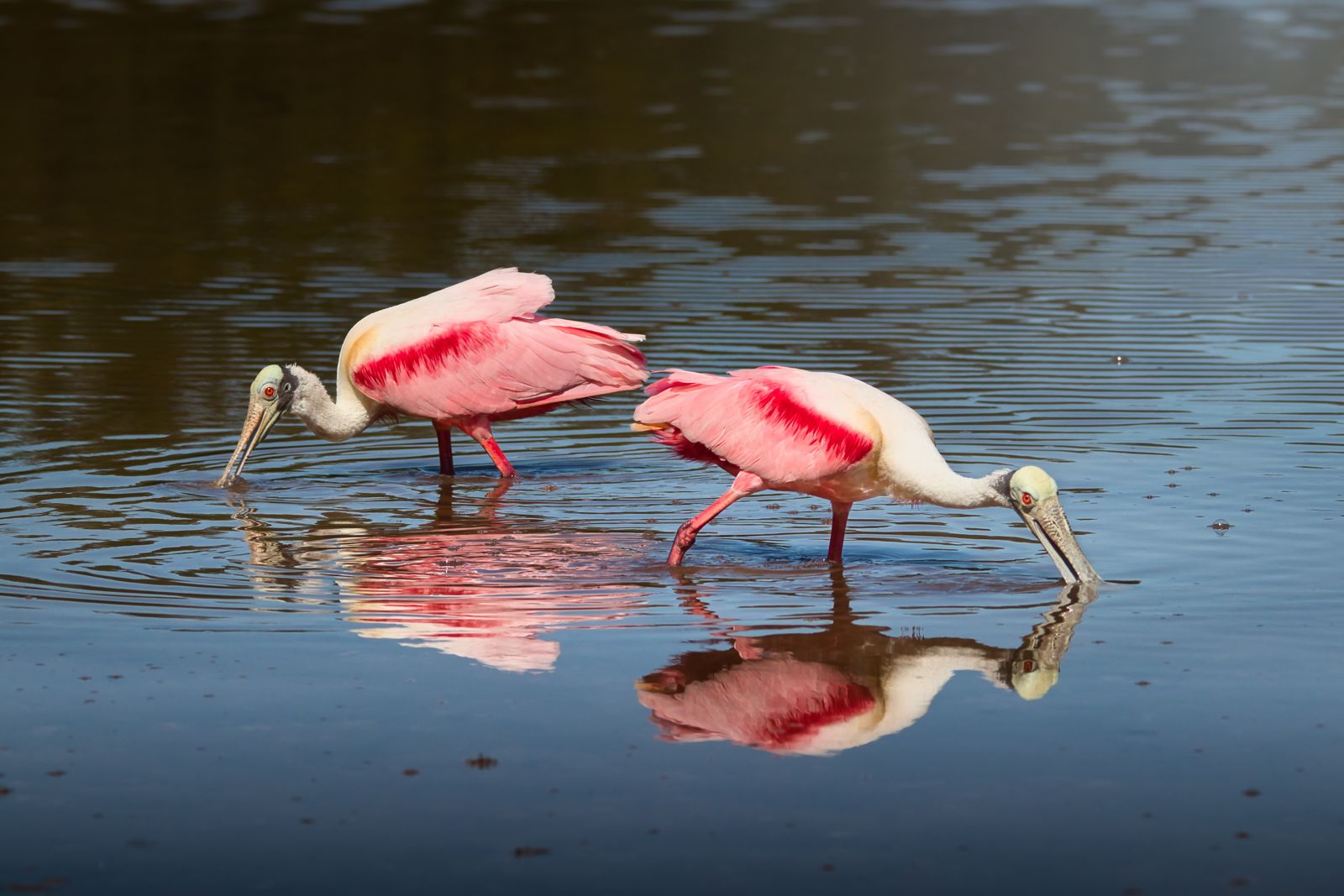
- Wading birds: the park counts sixteen species. The white ibis is the most common; others include great blue and great white herons, great and snowy egrets, tricolored and little blue herons, night herons, and the pink roseate spoonbill.
- Wood storks: endangered until June 2014, now listed as threatened. In early spring a wood stork rookery fills the mangroves at Paurotis Pond.
- Roseate spoonbills: from November through March more than two hundred breeding pairs nest on islands in Florida Bay. Watch for them flying over Flamingo.
- Anhingas: the bird the Anhinga Trail is named for, and one the park lists among the trail’s regulars.
- Snail kites: the park mentions this endangered bird of prey along the Shark Valley tram road and on the Nine Mile Pond canoe trail.
The best months are the dry ones, when falling water concentrates fish. For the season-by-season detail, see our guide to Everglades weather and the best time to visit.
Mammals: what you might see, and what you won’t
More than 40 species of mammals live in the park, but most are shy, small or nocturnal. Realistic sightings:
- River otters: commonly seen in spring at the Anhinga Trail and Shark Valley.
- White-tailed deer: the same species as elsewhere in the eastern United States, the park notes, but smaller.
- West Indian manatees: in the park’s words, drifting through its tranquil waters; the park suggests watching for them from the Flamingo marina.
And the one almost nobody sees: the Florida panther. The park names it, with the American alligator, among the 36 threatened or endangered species that live here, and its own mammal page calls the panthers elusive. Treat the panther as a story, not a sighting.
Pythons: the question everyone asks
Burmese pythons are the most famous problem in the Everglades, and the park is direct about both halves of the story. First, the reassurance: park visitors are unlikely to see a python in the wild. They are secretive and well camouflaged.
Second, the damage. The park says pythons became established through the accidental or intentional release of captive pets, and that studies show they are probably the main reason mammals have declined very sharply in number in the park. Removing them, once established, is extremely hard and expensive. If the mammal list above sounds thinner than you expected, this is part of the reason.
A damaged river, and the biggest repair job in the country
The other reason the Everglades can feel quieter than the old accounts is water. Canals, levees and roads built over the last century cut the slow flow from Lake Okeechobee to Florida Bay; the park’s geology page says people have forever altered the once-steady flow of the river of grass.
The response is the Comprehensive Everglades Restoration Plan. The park describes it as costing more than $10.5 billion over a timeline of more than 35 years, the largest hydrologic restoration project ever undertaken in the United States. The park stresses that restoration depends on the quantity, quality, timing and distribution of water, and that the effort to restore historic bird numbers has been slow. A visit is, in part, a look at a system in the middle of a long repair.
What disappoints people
It is worth being honest about the common complaints:
- It is flat. That is the point, but if you have just come from the Grand Canyon, the first view can feel like nothing. The Shark Valley observation tower and the Pa-hay-okee Overlook help.
- It is big and the parts do not connect. Shark Valley, the Homestead entrance and the Gulf Coast are separate trips. Flamingo is 38 miles from the Homestead entrance station. Trying to do everything in a day means mostly driving.
- Summer is tough. From May to November the park describes average highs of 90°F, humidity over 90%, a heat index over 100°F, daily afternoon storms and, in places, profuse mosquitoes. Wildlife disperses as water rises.
- Winter is busy. At Shark Valley, peak season parking usually fills by 10 a.m.
- No swimming, no drones, and patchy phone signal in the remote south, where generally only AT&T works west of Nine Mile Pond.
- Airboats are not everywhere. Inside the park they run only from three operators on the Tamiami Trail.
How to make it worth it
- Go in the dry season if you can, roughly December to April.
- Pick one area and do it well rather than racing between entrances. Our guide to things to do in the Everglades breaks it down by entrance.
- Mix a boat with a boardwalk. A boat or tram covers distance and comes with a naturalist; a slow walk on the Anhinga Trail gives you the close-up wildlife.
- Start early. Cooler air, active animals, fewer people and, at Shark Valley, a parking space.
- Bring binoculars, water, repellent and lunch. Food in the park is limited to snacks in a few places.
How much time do you need?
Less than people fear, as long as you choose one area:
- Half a day: Shark Valley (tram or bike to the tower) and an airboat ride nearby on the Tamiami Trail, or the Anhinga and Gumbo Limbo trails at Royal Palm.
- A full day: the drive from the Homestead entrance to Flamingo, with boardwalk stops on the way and a boat tour at the end.
- Two days or more: both of the above, or a night at Flamingo with time to paddle. Add the Gulf Coast if you are driving on to Naples.
Is a tour worth it?
A guided trip solves the two hardest parts of an Everglades day: getting there without a car, and knowing what you are looking at. Each type shows a different side:
- Airboat rides are fast and loud and cover a lot of sawgrass in a short time. Good for a first taste and for families; less good for quiet birdwatching. Check what each package includes before you book.
- The Shark Valley tram is a two-hour narrated loop into the heart of the river of grass with a stop at the observation tower.
- Boat tours from Flamingo and Everglades City are 90 minutes with a naturalist, into mangroves and open bay.
- Guided kayak trips are the quietest way into the mangroves, and the closest you will get to the water.
Our airboat guide compares these side by side, getting to the Everglades from Miami covers transport, and the tours page lists what is available to book.
The verdict
The Everglades rewards people who come for what it is: a slow, flat, enormous wetland where big wildlife lives in plain sight of the paths. Come in winter, give it at least half a day in one area, get out on the water once, and walk one boardwalk slowly. If you do that, it is very much worth the drive.